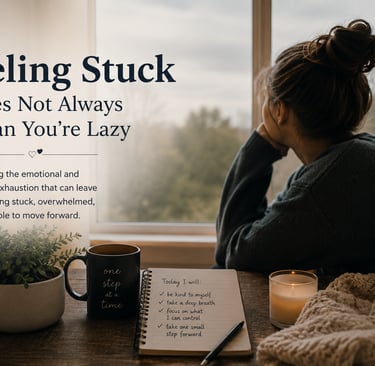
Feeling Stuck Does Not Always Mean You're Lazy
Exploring the emotional and mental exhaustion that can leave people feeling stuck, overwhelmed, and unable to move forward.
WELLNESS & RESET
PaletPage Editorial
5/27/20263 min read

Feeling Stuck Does Not Always Mean You're Lazy
When everyone expects too much of you, the last thing you consider is yourself. Responsibilities start to take precedence over any other area of your life. Prioritizing important tasks to keep things running smoothly makes you feel in control, even when the facts say the opposite.
Losing weight, meeting new friends, joining a gym, and even starting a new hobby can start to feel like far-fetched dreams, even if they are within your grasp.
Excuses May Be A Call For Help
When the words "I am too busy to do anything" fall out of your mouth more easily than saying "Stop," you may be in survival mode.
The following symptoms are commonly associated with mental fatigue and survival mode.
difficulty relaxing
lack of motivation
overeating or undereating
difficulty in making decisions
mood swings
sleeplessness
always on the run, without getting anything done
“While our body’s clever stress response evolved to protect us from life-or-death threats such as an angry woolly mammoth, our busy modern lives today involve non life-threatening stressors that can still trigger our fight or flight response: such as deadlines, work emails, and even heavy traffic. Being in fight or flight affects not just the mind but the body – it raises blood pressure and heart rate for example. And long-term, a dysregulated nervous system (being in survival mode) is unhealthy for both the mind and the body.” says Dr. Kilmowicz, a consultant psychiatrist from The London Psychiatry Center.
Survival mode appears differently in people, looking like anxiety in some, while in others it is experienced as depression or lack of energy. Staying busy throughout the day, without seeming to win the battle, is one of the ways it introduces itself. 24 hours seem not enough to accomplish all you set out to do, while it seems your best friend or sister can do much more in less time.
Trauma or prolonged stress is partly to blame, according to a Harvard Health Publishing article on understanding our stress responses. The stress response starts in the brain - when faced with danger or stress, the "eyes and ears (or both) send information to the amygdala, an area of the brain that contributes to emotional processing."
Over time, if we do not deal with our fears or trauma triggers, the body starts to adjust. Prolonged release of stress hormones that trigger the "fight-or-flight" response, a survival mechanism, starts to take its toll on the body. Lack of focus, depression, and high alert levels are all significant responses to look out for.
Because these changes happen rapidly, people tend to forget what started their symptoms. Life starts to demand more and more, and it seems as if the mere thought of stopping, resting, and resetting your brain is impossible.
Resetting Your Mind
Resetting your mind and body is one of the easiest and most effective ways to regain control. Using effective tools can help you better understand your feelings. Determining the root cause of problems will not only have a positive impact on your own life but also on the lives of those around you.
The Reset Journal as a Support Tool
The Free Reset Journal will help you take manageable steps to take back control. Small changes become easier to manage when you start with realistic, repeatable steps.
A Reset Journal Can Help With:
setting time aside for yourself
identifying short-term goals
understanding emotional obstacles
creating manageable action steps
tracking progress over time
The focus must not be on an overnight change or recovery. Staying realistic and positive is the correct mindset when trying to break free from life-altering patterns. Small, manageable routines are often easier to maintain than dramatic overnight changes.
Repetitive Behavior Is the Key
Neuroplasticity, or the "neural plasticity of brain plasticity," according to the National Library of Medicine, is the process by which the nervous system can learn a new skill or experience. New habits can be trained. Our brain can "change" when we introduce it to new emotions and repatterning words, thoughts, and actions daily.
To break trauma and survival-mode conditioning, we need to change neural pathways by introducing new experiences. Repetition helps the brain form a lasting sense of safety and security, which helps you recover from long-term trauma or negative associations.
Using a Reset Journal Will Help You Stay:
consistent routines
improved focus
motivated
accountable
realistic goal tracking
Starting each day with healthier thought patterns, structured routines, and clear short- and long-term goals can help create a strong sense of direction over time.
If you feel it is time for a positive change, need a nudge to move forward, and want to stop staying stuck, our FREE Reset Journal might be the answer you are looking for.
Download the Free Reset Journal and begin taking small, manageable steps toward rebuilding structure and consistency.
Reference:
Connect
follow for practical ideas, new resources, and fresh updates
© 2026. All rights reserved.